

Crash, 2026 Archival pigment print on fine art paper, stainless steel 71 x 51 x 4 cm, engraving text on stainless steel 70 x 50 x 3.5 cm

Installation view
Crash, 2026 Archival pigment print on fine art paper, stainless steel 71 x 51 x 4 cm, engraving text on stainless steel 70 x 50 x 3.5 cm
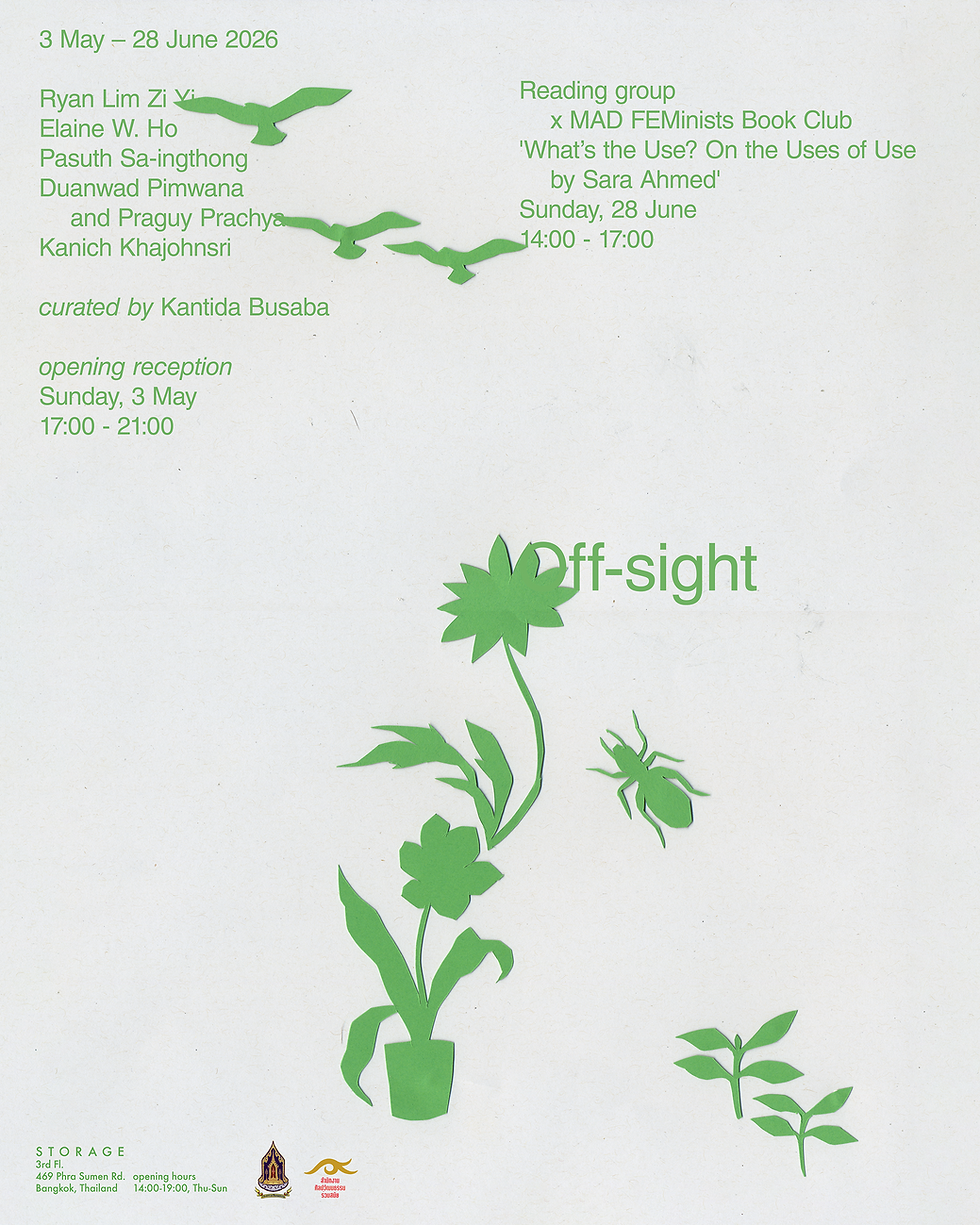
Off-sight
Ryan Lim Zi Yi
Elaine W. Ho
Pasuth Sa-ingthong
Duanwad Pimwana and Praguy Prachya
Kanich Khajohnsri
Curated by Kantida Busaba
3 May - 28 June 2026
Off-sight, a group exhibition featuring works by Ryan Lim Zi Yi (Singapore), Elaine W. Ho (Hong Kong), Pasuth Sa-ingthong, Duanwad Pimwana and Praguy Prachya, and Kanich Khajohnsri. Bringing together previously exhibited works alongside newly commissioned pieces, the exhibition spans writing, photography, video, and site-responsive practices. Its selection and installation form an attempt to think alongside the context, conditions, and limits of both space and language.
“To be seen, or to choose to hide.
To be watched closely, or passed by without notice.
To get ready to begin again,
or to still be on the way to failure.
Maybe what awaits has no roots,
yet elsewhere in time, it stands in plain sight.
Built from what was left behind,
from things once called worthless,
from hopes that were pushed away.
Converging, accumulating, dispersing.”
Off-sight is a pairing of two words chosen to become the exhibition’s title. Yet neither is intended as a definition of the works themselves. Rather, they gesture back toward the initial impulse to tell a story—to begin from what does not grant us time to think. This may be a kind of feeling that resists language, or conversely, one so easily named that it slips past reflection. It may be an event so ordinary it appears inseparable from daily life and therefore escapes notice; a mode of storytelling out of step with prevailing taste; or ways of living and working that stray beyond the standard line of the majority. These matters are embedded in the thinking of the works as much as in their making, culminating here in the form of an exhibition.
Two works by Ryan Lim Zi Yi; Tremors (2023) and Crash (2026) present states of sudden upheaval with striking directness. The artist’s attention to a split second in time, to chance, the unforeseen, and its aftereffects, is conveyed through materials and objects familiar from everyday life. As the ordinary reveals itself within the gallery, his works tease memory, ungovernable feeling, and the chaos of narratives turned upside down. The instability of life that can emerge in such moments may, for some, feel no different from turbulence mid-flight.
It is in this register that Elaine W. Ho’s site-specific work, We will be touching down shortly (2026) appears: a situation disguised as an unjoined seam, a passage, a slow erosion. Developed through the artist’s prior encounters with the space, images of STORAGE are reconstructed and overlaid with the emotional mass of travel with the view from an airplane window before takeoff. We are first enclosed by immense structures, systems, and regimes of management, only then to arrive at a panoramic view in which everything becomes too small to distinguish. Even so, hope remains provisionally arranged: the possibility of freedom, the chance that renewal may still emerge through the cracks.
Kanich Khajohnsri’s disembodied (2026) extends from the installation project POSSESSION (2024), first shown in a botanical garden in Belfast. As the context of display changes, what was once a photograph printed on fabric becomes a sticker print pressed into the glass. The allusion—and in another sense, the dependence between trees and cemetery speaks to the makeshift and temporary disarray through which time moves. Shifting sight-lines alter with the architecture. A deep black hollow recessed into the cemetery opens through to the emptiness beyond, inviting reflection on storage as a provisional condition of containment.
This interval of empty space meets the video works of Pasuth Sa-ingthong's Call it what you will (watching shadow go by I) (2026) and Call it what you will (watching shadow go by II) (2026), in which the artist leaves distance and visibility to the habits of perception. What runs parallel is not only the screen and gallery, but the image narrating itself alongside the viewer’s own experience of seeing. Light and movement seem to approach a final form of freedom, prompting the question: how much of a life can ever be free from control? Perhaps it is as the poetry of Duanwad Pimwana and Praguy Prachya suggests: at times desire may appear clearer than the thing desired. Ambiguous intentions and the consequences of action do not always remain faithful to their point of origin.
Extending from the exhibition is a public programme in collaboration with MAD FEMinists Book Club (MADFEMs), centred on What’s the Use? by Sara Ahmed. What is this for? What use does it have? These are recurring questions, often summoned to justify or negotiate the reasons for beginning. Yet perhaps, unintentionally, such questions arise because certain things are out of place, misaligned with familiarity, as it is said in the book, “It is not surprising that when the world is not used to you, when you appear as unusual, use becomes what you question.” ¹
¹ Sara Ahmed, What's the Use? On the Uses of Use (Duke University Press: 2019), 3
About the artists and contributors:
Ryan Lim Zi Yi is a Singapore-based artist. His practice revolves around searching for the extraordinary within the unspectacular, revealing the overlooked as something tender and worth remembering. He choreographs these moments with narratives that explore memory, identity, reality and fiction. His work unfolds across photography, video, sculpture, text and installation. Lim's works have been presented in solo and group exhibitions in Singapore and internationally. In addition to his practice as an artist, Lim currently runs BACKYARD, a subscription-based publication housing artists reports of happenings and news around Singapore. His curatorial projects also include Robin (2022-2023), a series of exhibitions presented in camping tents pitched in various locations across Singapore.
Elaine W. Ho works between … leaves … comes back round again … carries … is currently based in … takes from … is indebted to … copies that … Copy that? She tears up when reading the biographies others write for themselves, finds herself in others, and all that is really to say … many, many matters, many others … ‘when everything came together and folded’ … i wish i could describe it to you better.
Pasuth Sa-ingthong is a Bangkok-based multidisciplinary artist and visual alchemist. He creates artworks that explore abstract textures while delving deep into the intricate connections between the physical and digital realms. His fascination with fractal structures, combined with his work with particles,which reflects the complex dynamics and movements of his surroundings, serves as a profound influence that adds depth to his exploration of these themes. He translates these elements into visual experiences that highlight the harmonious fusion of the environment and technology.
Duanwad Pimwana is the pen name of Pimjai Juklin, an author who lives in Chonburi, Thailand’s eastern seaside city. She writes in various forms, including short stories, poetry, novellas, and cross-genre fiction. Her works have received awards from PEN International Thailand, the Thai literary magazine Chorkaraket, and, in 2003, the S.E.A. Write Award for her novel Changsamran, translated into English by Mui Poopoksakul as Bright (Two Lines Press, 2019).
Praguy Prachya is as much a poet as he is a devoted reader, having honed his craft since junior high school and continuing to write poetry today. He came of age during a period of political violence, including in the shadow of the October 6 Massacre, experiences that compelled him to put pen to paper. He lives and works in Chonburi.
Kanich Khajohnsri is always interested in space, demarcations, and overlaps between spaces. Through observations in Bangkok, he noticed the ambiguity resulting from the overlaps between private space ownership that took over public spaces. Kanich had initially developed this idea about ambiguous space and how the spaces are configured and perceived in response to their context. Currently interested in how materials and objects hold ambiguous meanings and operate as mediums of authority and power, as well as in the “ambiguity of space” — how places and landscapes become layered through context, narrative, social relations, and the perceived meanings of those who engage with them.
Mui Poopoksakul is a literary translator and an attorney. She is the translator of Duanwad Pimwana’s novel Bright (Two Lines Press, 2019) and story collection Arid Dreams (Feminist Press, 2019). Mui lives in Berlin, Germany.
MAD FEMinists Book Club (MADFEMs) is a group of friends sharing feminist values who come together to foster a safe space for like-minded feminist friends and queer folks, where we can question, critique, and exchange ideas that otherwise run counter to hegemonic social norms. Our discussions involve power, structures, patriarchy, colonial mindset, and many other inextricable intersectional themes through the feminist lens. We are weaving these conversations through books, alongside other texts such as films, screenplays, and manifestos, as well as workshops and table talks.
About the curator:
Kantida Busaba is an art practitioner who is drawn to the textual and the spatial, the spoken, the printed, and collective gestures as well as the shifting edges of artistic practice, where ideas resist fixation and forms of quiet resistance emerge. Her work explores how lives are shaped by economic and political conditions, and how power is articulated and knowledge might be shared otherwise through publishing, public programming, and exhibition-making.
She currently serves as Public Program Curator at BANGKOK CITYCITY GALLERY and is a member of GMT+, a multidisciplinary art collective based in Thailand.
Work list:
Elaine W. Ho
We will be touching down shortly, 2026
Sugar paste, A6 digital print on paper
Kanich Khajohnsri
disembodied, POSSESSION project 2024-ongoing
Inkjet print on translucent sticker
42 x 52.5 cm
Pasuth Sa-ingthong
Call it what you will (watching shadow go by II), 2026
HD video, 50 min, loop
Call it what you will (watching shadow go by I), 2026
Full HD video, 50 min, loop
Ryan Lim Zi Yi
Tremors, 2023
Polystyrene lamp shade, motor, light, wood
Dimensions variable
Crash, 2026
Archival pigment print on fine art paper, stainless steel
71 x 51 x 4 cm
Engraving text on stainless steel
70 x 50 x 3.5 cm
หว่านพืช - ระวังผล (You Reap What You Sow) a poem by Daunwad Pimwana and Praguy Prachya, translated into English by Mui Poopoksakul, included in the book อาชญารมณ์ต่อเนื่อง (Aan Press: 2013)
ACKNOWLEDGEMENT:
STORAGE programme is supported by the Office of Contemporary Art and Culture, Ministry of Culture (Fiscal Year 2026)
Mui Poopoksaul, translator of ‘You Reap What You Sow (หว่านพืช – ระวังผล)’, a poem by Daunwad Pimwana and Praguy Prachya
MADFEMs Community
Installation team: Paraform Studio
Poster design: Theetat Thunkijjanukij