

Installation view

Installation view
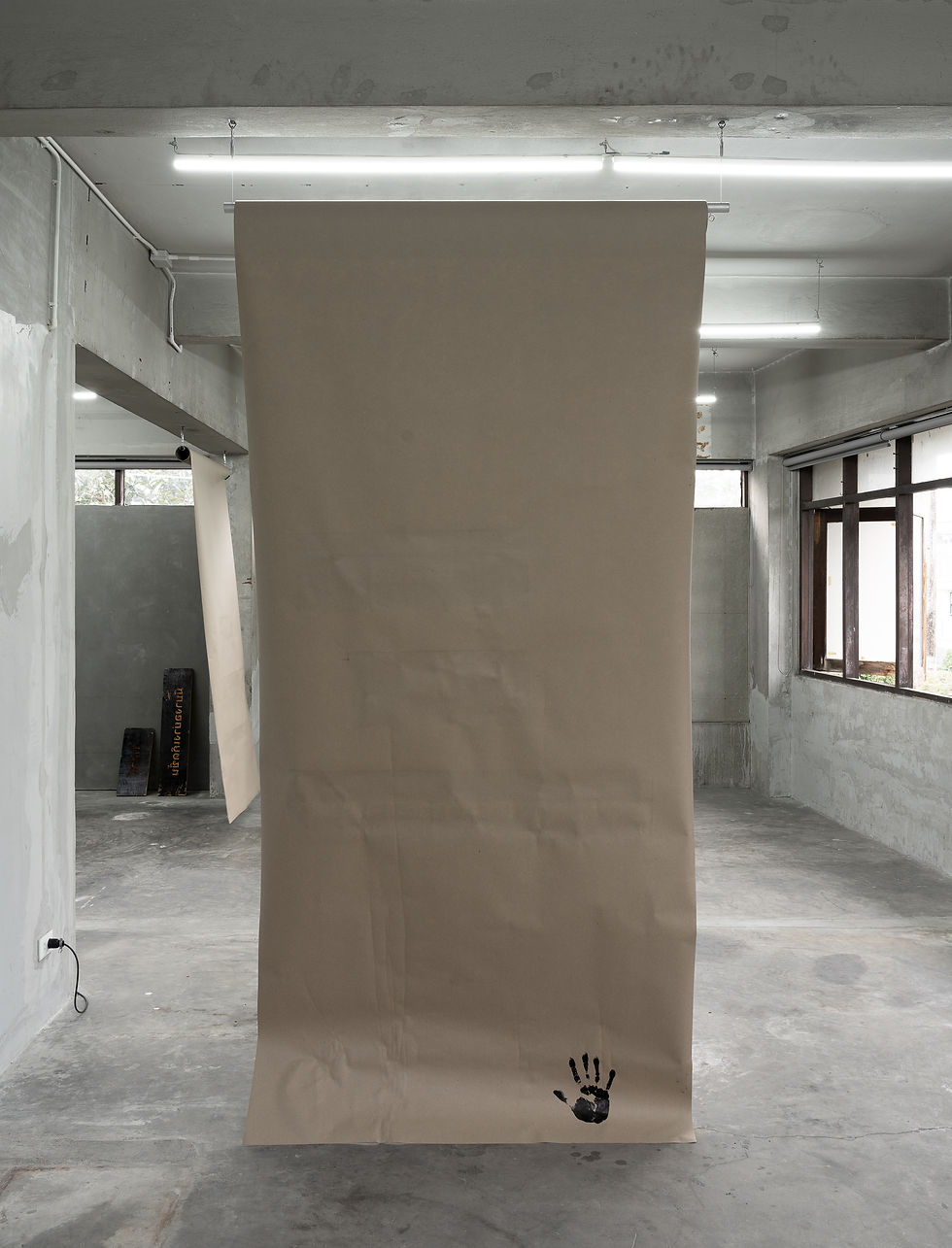
UNDER PRESSURE, 2023 Performative process & 3 woodblock prints, 7 wood blocks Dimensions variable
Installation view
[im]print
Progressive Disintegrations (Chua Chye Teck, Marc Gloede, Hilmi Johandi and Wei Leng Tay) with guest artist Tanatchai Bandasak
19 October - 10 December 2023
[im]print stands as the latest artistic endeavour from the Singapore art collective, Progressive Disintegrations. Marking their inaugural international collaboration, the collective partners with Thai artist Tanatchai Bandasak, whose conversation with members of Progressive Disintegrations first began during a residency in Singapore in 2019, and the Bangkok art space STORAGE.
Rooted in the building’s historical context, this collaborative venture gives rise to an exhibition wherein the essence of print takes centre stage. STORAGE, situated within a former printing press in Bangkok, becomes the focal point of this exploration. Building upon Progressive Disintegrations’ prior project in Singapore which examined the concept of the White Cube and the collective’s deep interest with the unique spatial configurations of exhibition sites, this exhibition project dives into the intricate layers of printing and imprinting. Individually and collectively, members of Progressive Disintegrations delve into diverse aspects of the printing process, exploring the idea of print through various mediums such as photography, painting, installation, woodblock prints, performance, and published materials.
Together with guest artist Tanatchai Bandasak, the group contemplates how the site’s history and the artists’ individual practices can intertwine, giving rise to a project that melds architectural inquiry, memory, relational dynamics, and cultural exchange, all through an expansive lens of printed art forms.
This exhibition at STORAGE is the sixth presentation of resultant works, and invites the audience to spatially experience the outcome of this process and the correspondences and echoes in the works. The fifth iteration of the collaboration – a book installation developed prior to the exhibition - can be seen right in the entrance to the exhibition.
When we think about a printed exhibition publication and its relationship to a corresponding exhibition, a temporal structure is often introduced in which the publication is necessarily a follow-up that occurs only after the exhibition is realised. For [im]print, the artists wanted to reverse this timeline and conceptualise a book project that would serve as a starting point for the project and all further developments, rather than being the end result. In this way, the book became an initial meeting point for individual ideas and experimentation with aesthetic strategies. This idea of establishing a book as a platform for initial experimentation was not just tied to the individual practices, but also allowed for thinking about ways to collaborate and correspondences between methods of working. This led to the form this book would eventually take. The result of this exchange – 5 stacked wooden boxes filled with works by the participating artists – can be seen right in the entrance of the exhibition. Upon request the boxes can be opened and the contents can be activated individually by the audience.
Marc Gloede’s UNDER PRESSURE (2023) is a work conceived for the exhibition [im]print at STORAGE, Bangkok. It focuses on the actual process of printing - more specifically, the process of woodblock printing and its relation to aspects such as physical pressure, time and materiality, which are connected to this medium. The result is a series of prints that address questions of originality, uniqueness, and repetition, as well as notions of the individual and collective work. This last point becomes tangible through the collaboration between Singapore and Bangkok. In a first step, together with Mary Pansanga and Tanatchai Bandasak, a series of words were translated into Thai. In the second step during the opening of the exhibition, three prints are executed through a series of performative actions.
Following in the footsteps of conceptual and minimalist performances, the actions are executed in three movements. The prints read:
1. (PRINT / IMPRINT / PROGRESSIVE DISINTEGRATIONS)
2. (PROVE / SOMETHING HAPPENED /
PROGRESSIVE DISINTEGRATIONS)
3. (YELLOW / PRESS / PROGRESSIVE DISINTEGRATIONS)
Specifically, the words of the 3rd movement bring to the fore the importance of context in relation to meaning, for all three movements, and the exhibition’s idea of the [im]print. In the 3rd movement, meaning can shift from discredited American printing and journalism practices (Yellow Press) that favour spectacle over truth, to a more art historical ‘imprint’ that one might associate with Lee Wen’s artistic practices in Singapore (the Yellow Man series). It can also invite potential readings of local/global political symbolic connotations–whether in Thailand, Hong Kong, or elsewhere in the world. But this aside, the printed words and wooden blocks together are, above all, evidence of the fact that a process has taken place and lead to further questions that go beyond solely textual or symbolic interpretations.
Chua Chye Teck’s Reading 1 & 2 are site-specific projects responding to the history of the Storage exhibition space in Bangkok, which used to be a publishing house and home of the house owner. The idea for the project was inspired by a book that was part of this very publisher’s catalogue: ‘Venerable Acariya Mun Bhuridatta Thera, Spiritual Biography’ by Acariya Maha Boowa Nanasampanno. The actual texts used in this case are the English translations of the book.
For the installation, Chua has extracted 2 paragraphs of the translated text based on Phra Acharn Mun’s teachings on the themes of communication, the mind and attachment. In terms of presentation, each paragraph of text will take a different form: in Reading 1 the first paragraph will take the form of a CNC laser cut text on a 1mm mild steel that has rusted. The paragraph will be placed in as a single, continuous, and uninterrupted line of text on the floor of the exhibition space vitrine, and direct the audience into different spatial experiences.
The second work Reading 2 will present a different paragraph of text in the form of 12 photograms (each 11 x 14 inch sized paper). Again all punctuation is removed, but this time a different rhythm is produced by only combining the photographs themselves to create a rhythm of both - text and images - on the wall, to create a new flow altogether. In both works the texts are presented in a manner that creates movement around the space that reminds of the meditative forest wanderings by Phra Acharn Mun.
Wei Leng Tay’s works shown in STORAGE are based on two different source materials: one work takes as a starting point a historical photograph of the family that ran the printing press where STORAGE is situated. In the other-three works, Tay re-visits her own photographic images produced 14 years ago in Bangkok’s Hua Lamphong.
In both cases, the artist invites the audience to think about what historical photographs (one’s own and that of others) mean, how photographic images age with time, and the materiality of the works. Colour becomes a photographic marker for remembering. How does colour create associations in one’s mind, and extrapolate from a singular history to that of many?
Also, the four works shift away from a purely representational mode and create abstractions by processes of enlargement or sanding. Specifically, this last process (sanding) opens up an interesting aspect to the process of printing: while prints come to life mostly through an additive process, Tay reverses this idea by grinding away certain parts of the print itself and in this way allow the base material of printing (paper) to re-appear again. It is what can be considered a form of de-printing.
The production of printed matter is a long process that begins with ideation, followed by numerous design and printing processes. While these various steps are often appreciated and valued as fundamental parts of the process, the acts of proofreading and corrections–similarly crucial as well–can be overlooked. Tanatchai Bandasak’s work, 5/364, changes this attitude by focusing on the proofreading marks of Sumitra Sornsongkam (the proofreader of the Chuanpim Printing Press), that he discovered in the book ‘PATIPADA Venerable Acariya Mun’s Path of Practice’ by Venerable Acariya Maha Boowa Nanasampanno. By using tracing paper to fill the entire page with a black granite/charcoal pencil, and leaving only these correction marks unfilled, Bandasak not only highlights her work, but also reminds us of the importance of critique in any creative process.
In Bandasak’s second work in the exhibition–a collection of defunct stones that were used to fixate paper or other objects in public places–a similar process can be seen. These stones, left behind all over the city, are brought back into consciousness.
The Placemaking series by Hilmi Johandi responds to the architectural features of the former Chuanpim Printing Press. Inspired by the distinctively patterned walls of the building, Hilmi’s works comprise drawings, paintings and cutout works on paper to explore the construction of imagined spaces that are rooted in realities. Additionally, these multi-layered collages and paintings challenge the spatial orientation that is integral in the everyday existence of architecture, where walls determine the flow and function of the space.
In Hilmi’s works the walls are allowed to function differently. Even though the artworks originate from images of the printing house, here the composed spaces don’t tend towards functionality. Instead, they lean into the dreamlike, fantasmatic, or towards surreal spaces. These are no nostalgic memories–these are fragmented constructions that allow the audience to lose their orientation and enter new spatial experiences.
About Progressive Disintegrations:
Progressive Disintegrations is a collaborative group project that began in early 2020 out of the need to create a format that provides a space to exchange creative and artistic practices between Chua Chye Teck, Marc Gloede, Hilmi Johandi and Wei Leng Tay. The project aimed to open normally individual artistic and curatorial practices up to those of others, creating situations to explore and expand the participants’ notions of their own practices.
Chua Chye Teck is an artist based in Singapore who employs both photography and sculpture to execute his ideas. He draws inspiration from things in the environment that catch his eye, which could include discarded items or remnants from nature, transforming them from their original state to take on a different context as works of art. Among various awards, Chye Teck was granted a one-year residency at Künstlerhaus Bethanien and launched his book “Beyond Wilderness” which was produced as a grant recipient of the National Arts Council’s Creation Fund.
Marc Gloede is a curator, critic and film scholar based in Singapore. His work focuses on the relationship between images, technology, space, and the body. It also examines the dynamics between art, architecture and film. He has curated exhibitions and programmes globally and has published widely. After beginning his career in theatre and performance, he later shifted towards art and curating. Previously, he was the senior curator of Art Basel’s film programme (2008-14). He received his PhD at The Free University of Berlin and has taught at numerous institutions. Gloede is currently Assistant Professor and Co-Director of the MA in Museum Studies and Curatorial Practices at NTU/ADM.
Hilmi Johandi is an artist based in Singapore who explores various interventions to expand his own image-making process beyond painting, questioning his intuitive relation to the medium. Hilmi makes paintings, installations, works on paper, and films depicting paradisiacal environments, often revealing the constructedness of representation. He revises images from film, archival footage and photographs into a fragmented montage where memory and nostalgia, leisure and desire become deeply entangled. In 2018, Hilmi was a recipient of the NAC Singapore Young Artist Award. His recent solo exhibitions include Landscapes and Paradise: Poolscapes, Ota Fine Arts, Tokyo, Japan (2021) and Painting Archives, Rumah Lukis, Kuala Lumpur, Malaysia (2019).
Wei Leng Tay is an artist based in Singapore who works across disciplines including photography, video, and installation. She uses formal strategies in installation, between image and text, materiality and spatial encounters, to question ingrained modes of perception and representation and photography’s relationship to contemporary society. An ongoing topical focus is movement and migration, in relation to ideas of difference and identity. She has exhibited with institutions including ARTER Space for Art, National Gallery Singapore, Fotomuseum Winterthur, and her works are in collections including those of Fukuoka Asian Art Museum, National Taiwan Museum of Fine Art, and Singapore Art Museum. She holds an MFA from Bard College.
with guest artist
Tanatchai Bandasak is an artist based in Bangkok whose practice spans a variety of mediums including objects, photography, moving image and installation. Often drawing on his interests in everyday life, ecological matter, geology to the archaic. Bandasak’s works open up our experience to something in a transitional state. He usually makes us aware of the blurred perimeter of the event, the shifting between two things allowing the drifting of the meaning and expanding our perceptions. Recent exhibitions include End Effect, Aey Space, Songkla, Thailand (2022); Open New Window, a pop-up exhibition by expensive to be poor, Bangkok (2021)